Sponsored Content
Data centres are infrastructure hubs that support many IT services across industries. Housing sensitive computing equipment, these facilities require stringent environmental controls to ensure operational reliability and hardware longevity. Poor air quality accelerates component degradation, leading to costly circumstances. In mission-critical environments like finance, healthcare, and telecommunications, maintaining optimal clean air is essential to prevent disruptions and enhance system resilience.
5 Causes of Corrosion in Data Centres
Corrosion is a leading factor in equipment degradation and failures. It is driven by the following environmental contributors:
- Humidity & Moisture: Excessive moisture causes condensation on metal surfaces, leading to oxidation and corrosion. This is problematic in regions with high humidity levels or where HVAC systems are not adequately regulated.
- Airborne Particulates: Dust and fine particles accumulate on circuit boards and heat sinks,
insulating them and increasing thermal stress. Chemically reactive particles, such as sulfates and chlorides, accelerate metal deterioration.
- Gaseous Contaminants: Industrial pollutants like sulfur dioxide (SO₂ ), hydrogen sulfide (H₂ S), and nitrogen oxides (NOₓ) interact with metal surfaces, forming corrosive compounds that degrade connections and circuits.
- Temperature Variations: Fluctuating temperatures cause thermal expansion and contraction of materials, weakening protective coatings and making hardware more susceptible to corrosion over time.
- Location-Based Pollution Exposure: Data centres near industrial zones, marine environments, or areas with high vehicular emissions are more vulnerable to airborne pollutants, increasing the risk of equipment corrosion.
Recommended Air Quality Standards for Data Centres
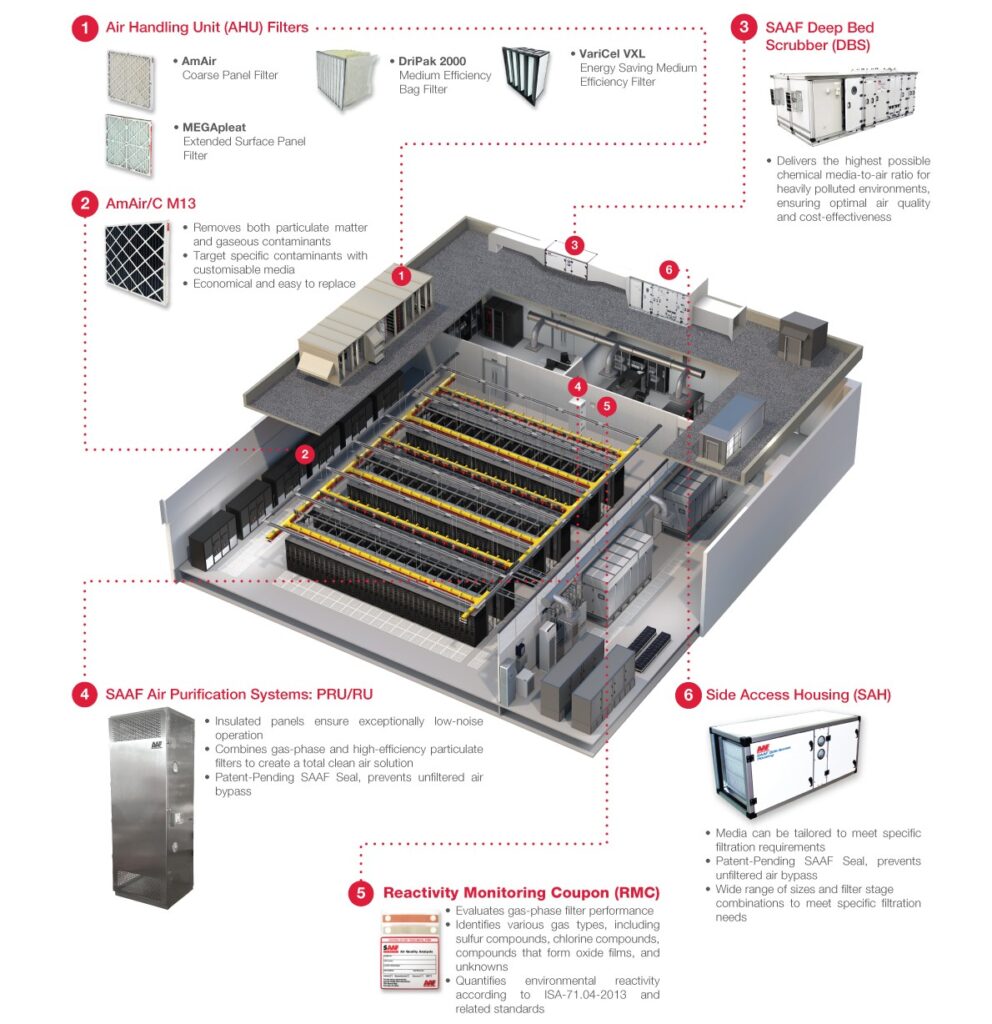
To ensure data centre reliability, maintaining optimal indoor environmental conditions is essential. The ANSI/ISA-71.04-2013 standard provides classifications for air quality based on the reactivity of copper (Cu) and silver (Ag) test coupons:
- G1 (Mild): Corrosion is negligible; this is the ideal environment for data centres.
- G2 (Moderate): Measurable corrosion that may influence long-term equipment reliability.
- G3 (Harsh): High probability of corrosion-related failures, requiring active environmental control measures.
- GX (Severe): Extremely corrosive conditions where only specialized, corrosion-resistant equipment can operate.
To maintain a G1 air quality level, data centres should implement the following measures:
- Temperature Control: Maintain consistent temperatures between 18°C to 27°C (64.4°F to 80.6°F) as per ASHRAE guidelines.
- Humidity Management: Keep relative humidity between a minimum dew point of 5.5°C (41.9°F) and a maximum of either 60% relative humidity or a 15°C (59°F) dew point to prevent electrostatic discharge and condensation.
- High-Efficiency Filtration: Deploy HEPA filters to remove dust and airborne particulates effectively.
- Gas Phase Filtration: Utilize gas phase filtration systems to neutralize corrosive gases and industrial pollutants.
- Continuous Corrosion Monitoring: Conduct regular air quality assessments and metal reactivity tests to detect and mitigate potential risks.
The Business Case for Air Quality Management
Investing in comprehensive air filtration and gas phase filtration solutions delivers significant operational benefits:
- Enhanced Equipment Lifespan: Minimizes corrosion-induced failures, extending hardware durability.
- Cost Savings on Maintenance: Reduces unplanned downtime and expensive repair or replacement costs.
- Optimized Energy Efficiency: Cleaner air prevents overheating, improving cooling performance and lowering energy consumption.
- Increased Operational Stability: Ensures uninterrupted functionality, mitigating the risk of system failures and data loss.
Want to experience all these benefits? Partner with AAF Asia to implement advanced clean air solutions that help minimize corrosion risks and optimize operational efficiency in data centres for long-term reliability.