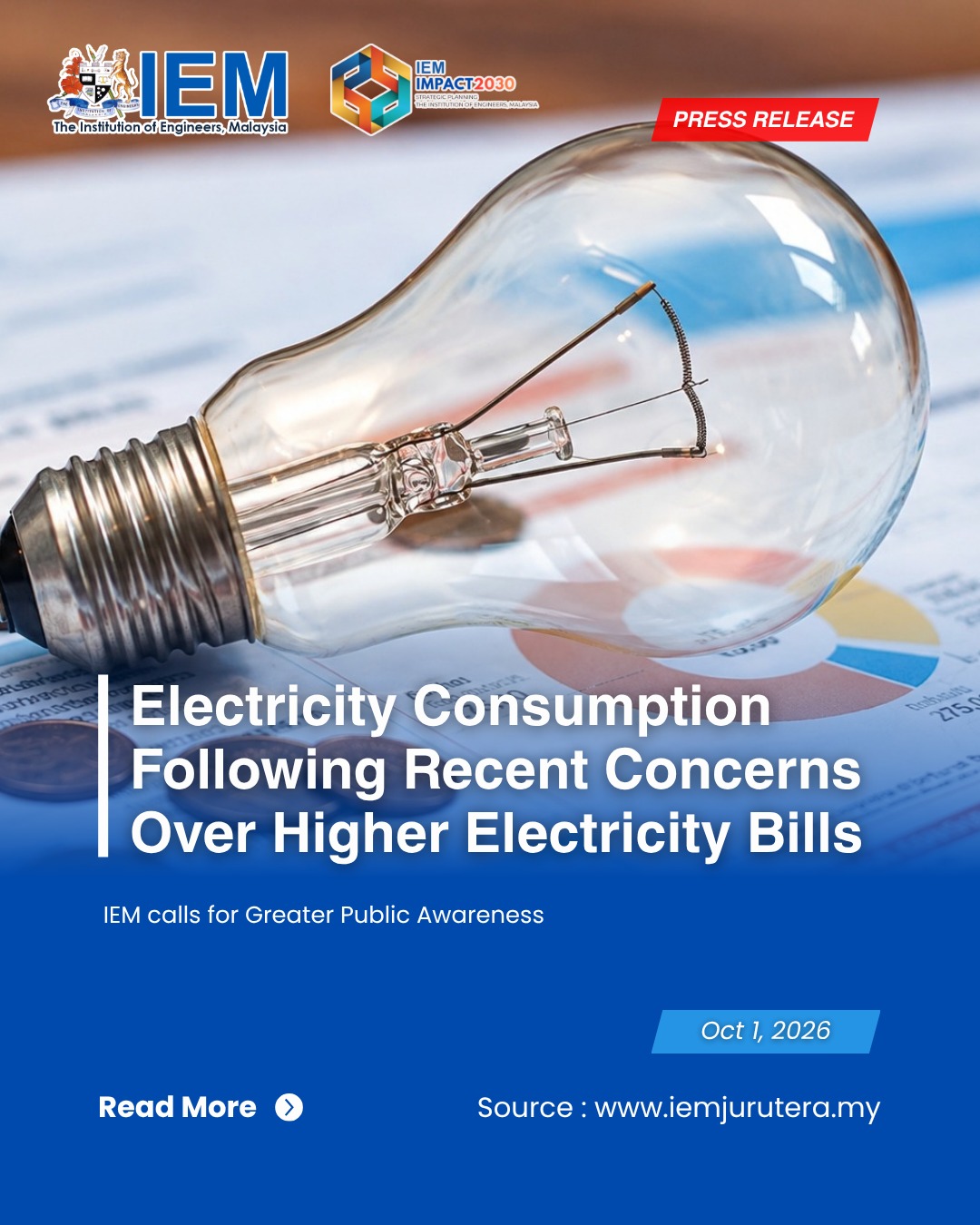
Kuala Lumpur, 1 October 2026 – The Institution of Engineers, Malaysia (IEM) takes note of recent public concerns regarding higher electricity bills experienced by some domestic consumers in Peninsular Malaysia.
As a professional engineering institution, IEM considers it important that the public is provided with clear and technically accurate information on how electricity consumption and the prevailing tariff framework affect monthly electricity bills.
Based on the information released by the Government, the Energy Commission (Suruhanjaya Tenaga) and Tenaga Nasional Berhad (TNB), the recent increase experienced by some households should be understood in the context of higher household electricity consumption, particularly where monthly consumption had increased beyond the previous 600 kilowatt-hour (kWh) protection threshold.
Recent hotter weather and haze conditions have contributed to increased electricity usage in some households, including greater utilisation of air-conditioning and other electrical appliances. Where this additional usage caused monthly consumption to exceed 600 kWh, consumers moved beyond the previous protection threshold and consequently became subject to bill components from which consumers at or below 600 kWh had been exempted.
AFA IS NOT A NEW ADDITIONAL CHARGE
IEM wishes to clarify that the Automatic Fuel Adjustment (AFA) is not a newly introduced additional charge arising from the recent electricity bill issue.
The AFA mechanism has been in effect since 1 July 2025, following the restructuring of the electricity tariff framework for Peninsular Malaysia. It replaced the previous Imbalance Cost
Pass-Through (ICPT) mechanism and provides a monthly adjustment to reflect changes in actual electricity generation costs, including movements in fuel prices and other applicable generation costs.
Importantly, AFA is a two-way adjustment mechanism. When applicable generation costs are below the reference level, consumers may receive an AFA rebate; when those costs are higher, an AFA surcharge may apply.
TNB has reported that consumers received approximately RM3.1 billion in AFA rebates since the mechanism was introduced in July 2025, compared with approximately RM800 million in surcharges over the same period. Consumers enjoyed AFA rebates for nine consecutive months from August 2025 to April 2026, before a surcharge began to apply from May 2026 following increases in generation costs.
For September 2026, the applicable AFA rate was +3.67 sen/kWh.
The important distinction is therefore that higher household consumption can have more than one effect on the electricity bill: consumers pay for the additional electrical energy consumed, while exceeding the applicable protection threshold can also cause previously exempted tariff components to become applicable.
UNDERSTANDING THE 600 kWh THRESHOLD
Prior to the Government’s latest intervention, domestic consumers using 600 kWh or less per month were protected through exemptions from AFA, the retail charge and the applicable service tax.
Accordingly, a household whose consumption increased from below 600 kWh to above 600 kWh could experience a noticeable increase in its monthly bill. This should not be interpreted simply as the introduction of a new tariff or an arbitrary additional surcharge.
Rather, the increase could arise from the combination of:
- higher actual electricity consumption;
- the consumer moving beyond the previous 600 kWh protection threshold; and
- the consequent application of tariff components for which the household was previously exempted.
IEM therefore encourages consumers to compare their monthly kWh consumption, rather than comparing only the Ringgit amount between consecutive electricity bills. The kWh consumption provides a more meaningful indication of whether a household’s electricity usage has materially increased.
GOVERNMENT’S ENHANCED PROTECTION UP TO 800 kWh
IEM notes the Government’s announcement on 17 September 2026 to temporarily expand electricity bill protection for domestic consumers from 600 kWh to 800 kWh per month, applicable to electricity consumption from September until 31 December 2026.
Under this measure, domestic consumers using up to 800 kWh per month will be exempted from AFA, the retail charge and SST during the stated period.
IEM welcomes measures that provide appropriate relief to consumers while maintaining transparency in the electricity tariff framework and ensuring the long-term reliability and sustainability of Malaysia’s electricity supply system.
The decision also provides additional protection to households whose electricity consumption may have temporarily increased due to prevailing weather and environmental conditions.
ENERGY LITERACY AND EFFICIENT CONSUMPTION REMAIN IMPORTANT
Electricity bills are fundamentally influenced by both the applicable tariff structure and the amount of electrical energy consumed.
For example, air-conditioning systems are typically among the larger electrical loads in residential premises. Longer operating hours, lower thermostat settings, poorly maintained equipment, inadequate building insulation and inefficient appliances can significantly increase monthly electricity consumption.
IEM therefore encourages consumers to adopt practical energy-management measures, including monitoring monthly and daily electricity consumption, maintaining air-conditioning equipment regularly, using energy-efficient appliances, optimising air-conditioning temperature settings and avoiding unnecessary electrical loads.
Where available and suitable, consumers may also consider the Time-of-Use (ToU) tariff arrangement and shift discretionary electricity consumption to off-peak periods.
Greater public understanding of kilowatt-hours (kWh), demand patterns, tariff components and energy efficiency will enable consumers to make more informed decisions regarding their electricity usage and household expenditure.
IEM SUPPORTS TRANSPARENT AND FACT-BASED PUBLIC COMMUNICATION
As Malaysia progresses through its energy transition, electricity tariff structures will increasingly need to balance several important considerations: consumer affordability,
security and reliability of electricity supply, the actual cost of electricity generation, efficient energy consumption, and the financial sustainability of the electricity supply industry.
IEM supports the efforts of the Government of Malaysia, the Energy Commission and relevant electricity industry stakeholders to provide transparent information and appropriate consumer protection while maintaining a secure and sustainable national electricity system.
At the same time, IEM encourages the public to assess electricity bills based on accurate information and to distinguish between increased electricity consumption, tariff components, fuel-cost adjustments and applicable subsidy or exemption thresholds.
IEM stands ready to contribute its engineering expertise towards strengthening public energy literacy and supporting technically sound, transparent and sustainable policies for Malaysia’s electricity supply industry.
Beyond this issue, IEM remains committed to promoting greater public awareness and understanding of engineering-related matters and topics that affect everyday life. Through the sharing of clear, accurate and technically sound information, IEM seeks to help the public better understand the role of engineering in areas such as energy, infrastructure, safety, technology and sustainable development, while supporting more informed decision-making within society.